Shift

Shift

Shift has been designed specifically for programmes rather than projects. We use the word ‘program’ for combinations of interventions that work together to achieve a change in health status such as reducing new HIV infections. Programmes are often on-going, as compared to projects that have an end date. Examples of programs are national or regional HIV prevention action plans or comprehensive services incorporating testing, counselling, outreach, needle exchange and condom distribution.

Shift is based on already existing tools such as the Global AIDS Response Progress Reporting (GARPR) set including the National Commitments and Policies Instrument (NCPI), used worldwide by UNAIDS and adapted for Europe by ECDC to collect relevant data on HIV programmes at the national level, and elements of the other already existing, validated quality improvement tools such as Succeed.

Shift and its supporting materials have been developed, tested and evaluated within the context of Quality Action.

Download Shift tool here (interactive pdf)

Shift tool is also available in the following languages (.pdf): HRFRITLTSLES

Download Shift factsheet: EN LTES

Supporting materials

Succeed

Succeed

An easy-to-use, evidence based QI questionnaire

Succeed is an easy-to-use tool designed to help HIV prevention projects assess their objectives and analyse their ability to meet them with sound, high quality activities.

It allows project personnel and, if required, representatives from the target group and other important stakeholders to jointly review the work and improve it during project implementation. Although relatively simple, Succeed is based on scientific research about success factors in the field of health promotion. It has been specifically adapted for use in HIV prevention. It can be used to review existing interventions or to review a plan for a new one.

Download the Succeed tool (.pdf) (interactive pdf); the interactive tool is a PDF that you fill in with your information. Please download the tool before opening it and entering any information. To fully access the document’s interactive features you need to upgrade to the latest version of Adobe Reader.

The Succeed tool is also available in the following languages (.pdf): DEGRITHRLTSK

Download the Succeed factsheet EN SKLT

PQD

PARTICIPATORY QUALITY DEVELOPMENT (PQD)

Quality Improvement with a focus on target group involvement

PQD is an integrated set of tools designed to help improve work practices. It relies heavily on the local knowledge of stakeholders and helps them use it, reflect on it and extend it. PQD includes a selection of participatory and evidence-based methods and processes that are tailored, feasible and useful for HIV prevention projects.

The methods and processes originate in different fields of health and social science theory and practice, and the toolkit has been used in general health promotion as well as in HIV prevention.

The PQD tool is available in the following languages: (EN) (IT) (DE) (LT) (HR)

Download a description of the PDQ tool in the following languages: (ES) (DE) (EN)

Download PQD factsheet here (.pdf)

QIP

QUALITY IN PREVENTION (QIP)

Comprehensive quality improvement by external expert assessment

QIP is a comprehensive quality improvement tool for health promotion and prevention projects. It uses external experts to assess a detailed documentation form filled in by the project. The questionnaire can also be used as a guide for the self-assessment of projects, programs or strategies.

QIP has been quality checked, tested in practice and adapted to the context of HIV prevention. It was developed in close partnership between the Federal Centre for Health Education (BZgA) and the University Medical Centre Hamburg-Eppendorf (UKE) in Germany.

Download the QIP Tool: EN – HR – ITLTSLES

Download QIP factsheet here (.pdf)

News

NEWS

Quality Action Conference 2016! Berlin, 26-27 January

“Doing the right things right!”

The conference was the concluding event of Quality Action, the EU co-funded ‘Joint Action on Improving Quality in HIV Prevention’, involving 45 partner organisations from 26 Member States, and took place in Berlin, Germany on January 26 – 27th 2016.

The event provided the opportunity to take stock of the latest developments in improving quality in HIV prevention, and brought together representatives from governmental and non-governmental organisations to share their experiences in applying practical quality improvement tools. Acting Direction John Ryan from the European Commission, HIV prevention leader Prof Kevin Fenton from Public Health England and quality improvement expert Prof Michael Wright from the Catholic University of Applied Sciences Berlin provided key input to the discussion.

Further highlights of the conference were the launch of a new Charter for Quality in HIV Prevention as well as the presentation of the project’s Policy Kit with policy statements and strategic actions to support quality improvement in HIV prevention at the national and regional levels. Furthermore, the conference provided opportunities to learn more about the concepts and tools of Quality Action.

The audience comprised more than 100 participants from across Europe, reflecting one of Quality Action’s main achievements, the creation of a community of quality improvement practitioners. Strong links across 26 EU Member States were formed during the project’s three year period. The commitment to continuing to improve quality and to coordinated action and collaboration that was evident at the event is key for a sustainable impact and further development.

The conference agenda is available here.

Read the conference report here.

Download the speakers’ presentations:

Session 1: Quality Action products and results in the context of HIV prevention in Europe

Prof Kevin Fenton – Keynote address: HIV prevention – what have we achieved? What does the future hold?
Matthias Wentzlaff-Eggebert – From ‘what works and why’ to ‘doing the right things right’ – history, approach and project overview.

Session 2: Evaluation results and recommendations for HIV policy and programme development

Christiana Nöstlinger, Bea Vuylsteke – Successes and challenges of integrating quality improvement in HIV prevention: results of Quality Action’s mixed method evaluation.
John Ryan – The HIV/AIDS policy framework of the European Commission and the links to Quality Action.
Ursula von Rüden – Quality principles and criteria for HIV prevention – evidence and experience.

Session 3: Quality Improvement in HIV prevention practice

Viveca Urwitz – Tools for action: from theory and experience to practical quality instruments.
Deirdre Seery – The Quality Action approach to capacity building.
Carolin Vierneisel – Make it fit – results, enablers and barriers of applying quality improvement tools in practice.

Session 4: enablers and tools for sustainable quality improvement

Prof Michael Wright – Keynote address: Quality in HIV prevention – making participation a reality.
Cristina Chiotan – The Quality Action website and future communication channels.

Session 5: strategies for sustainability and outlook

Vasileia Konte – National implementation of Quality Action in Greece – steps towards sustainability.
Daniel Simões – The road ahead… challenges and opportunities in sustaining Quality Improvement in HIV prevention.
Christine Winkelmann – Future perspectives for Quality Improvement activities.

For more information:


QI Tools

QI TOOLS

There are many quality improvement tools available, of which some are specific to health promotion activities. Quality Action offers a selection of five practical tools adapted or developed for HIV prevention to suit a wide range of projects and programmes. They are based on scientific evidence, practical experience and expert advice. All five tools encourage self-reflection and participation as important prerequisites for creating a culture of quality improvement. The tools themselves are complemented by the Tool Selection Guide, the Workshop Facilitation Guide, the training materials and the online learning resources also available on this site.

Criteria used to select and develop the tools offered by Quality Action:

  • Knowledge based – on published research or documented best practice;
  • Evaluated – documented evaluations proving that the tool works;
  • Suitable for HIV Health Promotion and Prevention – key elements and common concepts and language of the international HIV response integrated;
  • Practical and user-friendly format

For more background on the tools selected for Quality Action, download the rationale for tool selection here.

About This Site

GENERAL INFORMATION

This website has been developed as part of Quality Action, the: EU-wide ‘Joint Action on Improving Quality in HIV Prevention’. The site is managed by EuroHealthNet, a not for profit European network of organisations, agencies and statutory bodies working to promote health and equity by addressing the factors that determine health directly or indirectly. For further information about the organisation, please visit the website of EuroHealthNet.

Disclaimer

The website is intended for health professionals who wish to apply practical Quality Assurance (QA) and Quality Improvement (QI) tools for use in HIV prevention and policy makers interested in combating HIV/AIDS in the European Union.

EuroHealthNet makes no representations or warranties of any kind about the completeness, accuracy, reliability, suitability or availability with respect to the website or the information, materials, sources, services, or related graphics contained on the website for any purpose. Any reliance you place on such information is therefore strictly at your own risk.

This website links to third parties websites which are not under the control of the organisation itself. EuroHealthNet therefore has no control over the nature, content and availability of those sites. The inclusion of any links does not necessarily imply a recommendation or collaboration, or endorse the views expressed within them.

In case you leave your personal contact information, these details for those purposes indicated on the website. You will have the possibility to contact us in case you no longer want us to use your personal information for those purposes. Your personal contact information will not be forwarded to third parties.

Every effort is made to keep the website up and running smoothly. However, EuroHealthNet takes no responsibility for, and will not be liable for, the website being temporarily unavailable due to technical issues beyond our control.

EuroHealthNet shall have no liability for any errors or direct or consequential losses that you may suffer as a result of accessing or using this site, or for any damage or virus infection which may affect your computer or other computer equipment.

Terms of Use

You may download and use all online materials provided on the Quality Action site provided 1) you make no modifications to the materials; 2) you do not use the materials in a manner that suggest an association with any of the materials; and (3) you do not download quantities of materials to an external database.

All remarks, suggestions, ideas, graphics, comments, or other information that you send to EuroHealthNet through the Quality Action website will be evaluated by the organisation for relevance, reliability, validity and clarity. Submission of information is not a guarantee that it will be used and integrated into the website.

Linking to the Quality Action site

We encourage visitors to create hyperlinks on their own sites to the Quality Action website. In case you wish to make such a link, please use the following wording: “Quality Action website” or download the logo of the project here.
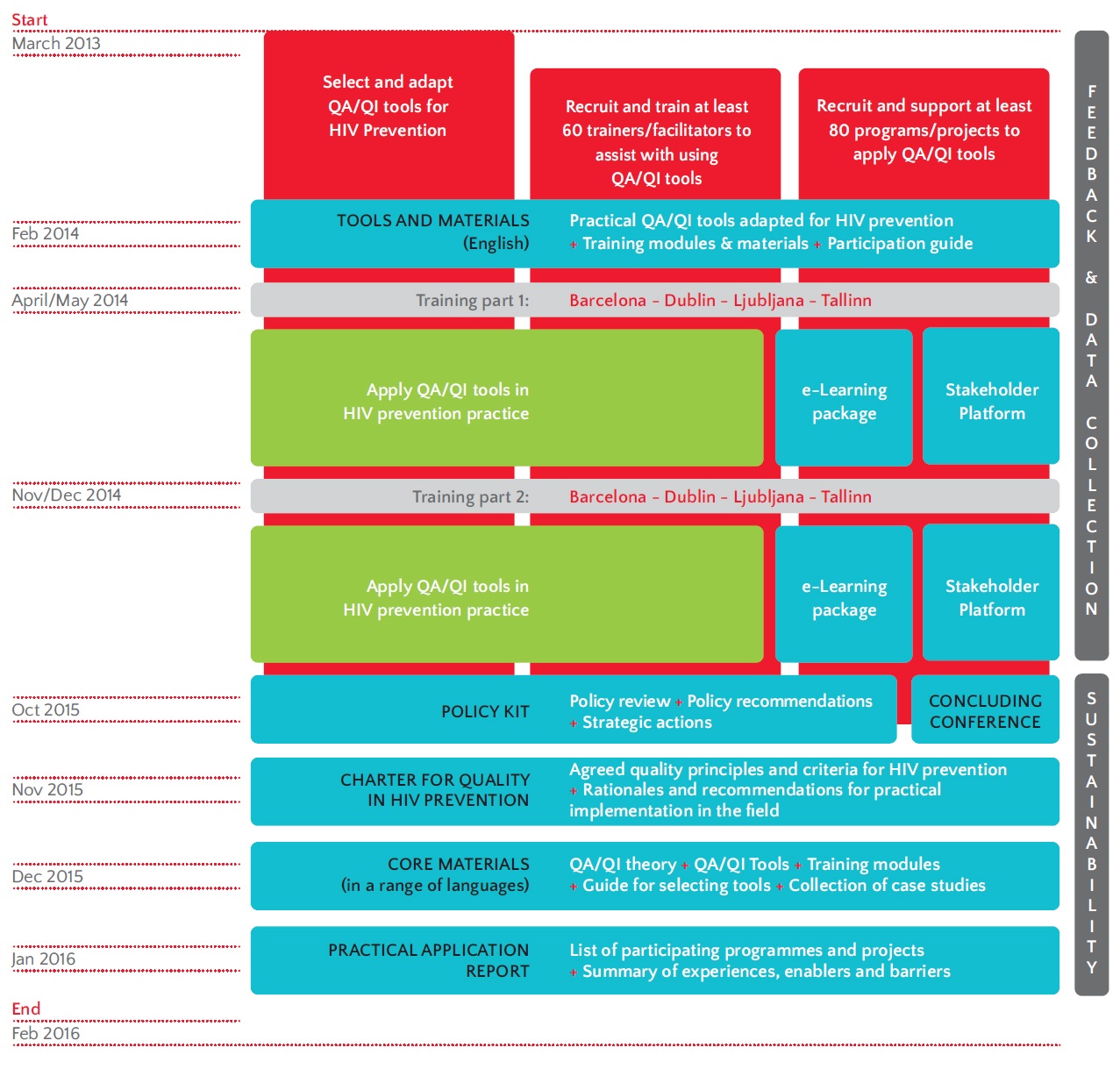
Timeline

QUALITY ACTION TIME LINE

Activities can be divided into three main phases, each about 12 months long:

  • Year 1: Promoting and organising participation and dissemination, getting quality improvement tools and training packages ready, preparing data collection and building expert and policy networks.
  • Year 2: Translating materials, organising regional training events, organising local workshops and application of tools, using the tools on HIV prevention projects and programmes, collecting results and evaluation data.
  • Year 3: Analysing results, developing the Charter for Quality and the Policy Kit, making final revisions to tools, training packages and other materials, holding the final conference, disseminating results and products, reporting.

Below you will find a schematic overview that sets out when which of the activities were planned to take place. For further information about the Quality Action activities and timeline, please download the ‘Project Roadmap’.