QI Tools

QI TOOLS

There are many quality improvement tools available, of which some are specific to health promotion activities. Quality Action offers a selection of five practical tools adapted or developed for HIV prevention to suit a wide range of projects and programmes. They are based on scientific evidence, practical experience and expert advice. All five tools encourage self-reflection and participation as important prerequisites for creating a culture of quality improvement. The tools themselves are complemented by the Tool Selection Guide, the Workshop Facilitation Guide, the training materials and the online learning resources also available on this site.

Criteria used to select and develop the tools offered by Quality Action:

  • Knowledge based – on published research or documented best practice;
  • Evaluated – documented evaluations proving that the tool works;
  • Suitable for HIV Health Promotion and Prevention – key elements and common concepts and language of the international HIV response integrated;
  • Practical and user-friendly format

For more background on the tools selected for Quality Action, download the rationale for tool selection here.
About This Site

GENERAL INFORMATION

This website has been developed as part of Quality Action, the: EU-wide ‘Joint Action on Improving Quality in HIV Prevention’. The site is managed by EuroHealthNet, a not for profit European network of organisations, agencies and statutory bodies working to promote health and equity by addressing the factors that determine health directly or indirectly. For further information about the organisation, please visit the website of EuroHealthNet.

Disclaimer

The website is intended for health professionals who wish to apply practical Quality Assurance (QA) and Quality Improvement (QI) tools for use in HIV prevention and policy makers interested in combating HIV/AIDS in the European Union.

EuroHealthNet makes no representations or warranties of any kind about the completeness, accuracy, reliability, suitability or availability with respect to the website or the information, materials, sources, services, or related graphics contained on the website for any purpose. Any reliance you place on such information is therefore strictly at your own risk.

This website links to third parties websites which are not under the control of the organisation itself. EuroHealthNet therefore has no control over the nature, content and availability of those sites. The inclusion of any links does not necessarily imply a recommendation or collaboration, or endorse the views expressed within them.

In case you leave your personal contact information, these details for those purposes indicated on the website. You will have the possibility to contact us in case you no longer want us to use your personal information for those purposes. Your personal contact information will not be forwarded to third parties.

Every effort is made to keep the website up and running smoothly. However, EuroHealthNet takes no responsibility for, and will not be liable for, the website being temporarily unavailable due to technical issues beyond our control.

EuroHealthNet shall have no liability for any errors or direct or consequential losses that you may suffer as a result of accessing or using this site, or for any damage or virus infection which may affect your computer or other computer equipment.

Terms of Use

You may download and use all online materials provided on the Quality Action site provided 1) you make no modifications to the materials; 2) you do not use the materials in a manner that suggest an association with any of the materials; and (3) you do not download quantities of materials to an external database.

All remarks, suggestions, ideas, graphics, comments, or other information that you send to EuroHealthNet through the Quality Action website will be evaluated by the organisation for relevance, reliability, validity and clarity. Submission of information is not a guarantee that it will be used and integrated into the website.

Linking to the Quality Action site

We encourage visitors to create hyperlinks on their own sites to the Quality Action website. In case you wish to make such a link, please use the following wording: “Quality Action website” or download the logo of the project here.

Timeline

QUALITY ACTION TIME LINE

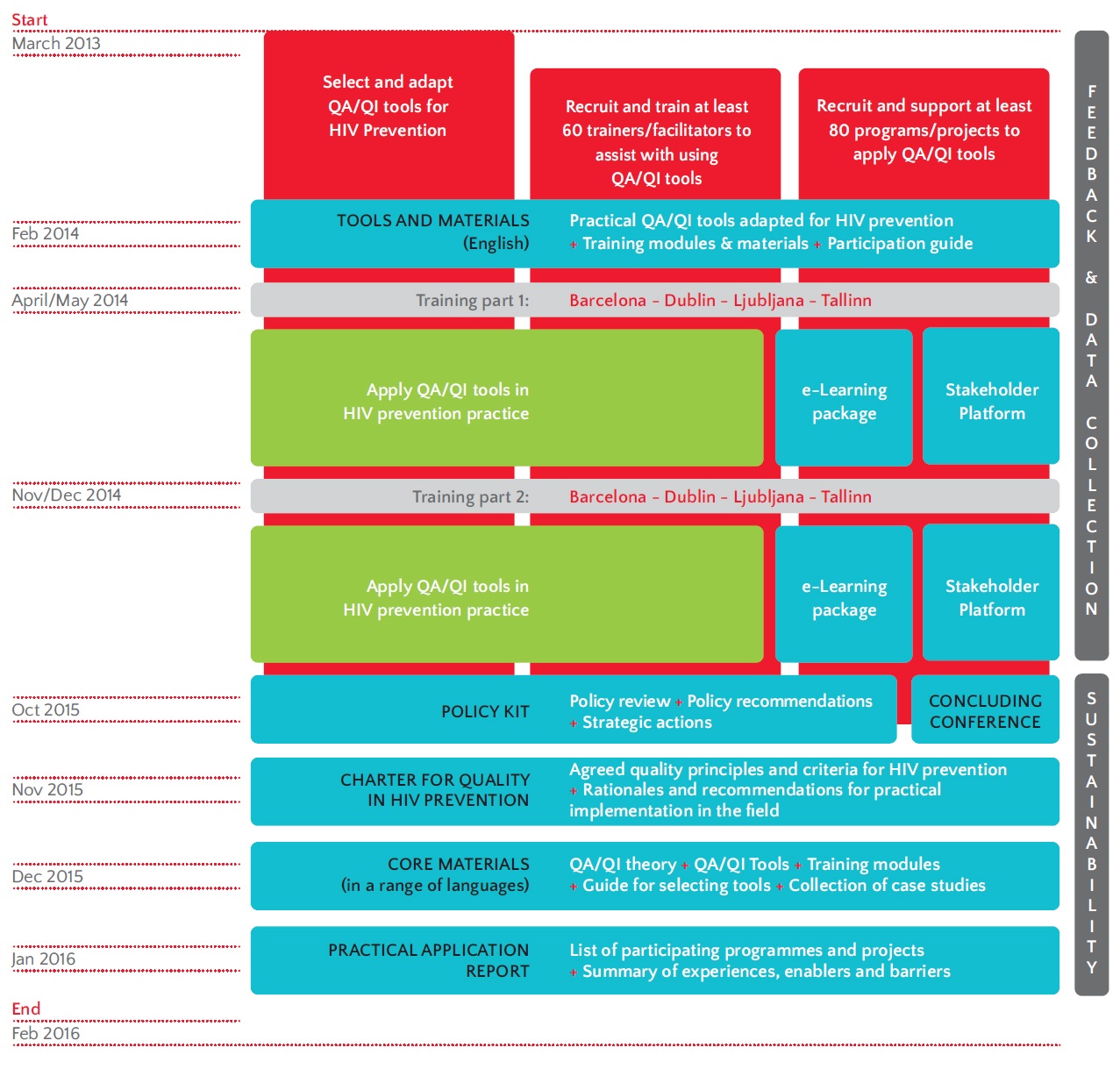
Activities can be divided into three main phases, each about 12 months long:

  • Year 1: Promoting and organising participation and dissemination, getting quality improvement tools and training packages ready, preparing data collection and building expert and policy networks.
  • Year 2: Translating materials, organising regional training events, organising local workshops and application of tools, using the tools on HIV prevention projects and programmes, collecting results and evaluation data.
  • Year 3: Analysing results, developing the Charter for Quality and the Policy Kit, making final revisions to tools, training packages and other materials, holding the final conference, disseminating results and products, reporting.

Below you will find a schematic overview that sets out when which of the activities were planned to take place. For further information about the Quality Action activities and timeline, please download the ‘Project Roadmap’.

Why?

WHY QUALITY ACTION?

Why is quality important?

HIV remains a major public health challenge in Europe and is an important cause of preventable mortality and morbidity. Ensuring HIV prevention activities are effective is crucial to reducing the incidence and impact of infection on individuals and communities, especially among the most vulnerable populations.

Approaches, interventions and methods for HIV prevention must not only be appropriate to the situation they address, they must be carried out at a high level of quality to maximise effectiveness. Structured quality improvement continuously seeks and makes use of opportunities to optimise implementation.

Why Quality Action?

Quality Action contributes to the implementation of the EU policy on HIV: ‘Combating HIV/AIDS in the European Union and neighbouring countries (2009 -2013)’. The overall objectives of this EU Communication are:
  1. To reduce new HIV infections across all European countries by 2013;
  2. To improve access to prevention treatment, care and support; and
  3. To improve the quality of life of people living with, affected by or most vulnerable to HIV/AIDS in the European Union and neighbouring countries.

The EU Communication calls for EU and Member State policy responses that meet the challenges of prevention, focus on priority areas and most at risk populations and improve the knowledge base through better cooperation and knowledge transfer among stakeholders. The policy sets out that the current HIV epidemic and expected future trends are best addressed through:

  1. Scaling up the implementation of prevention strategies that effectively target local realities and needs while working towards ensuring universal access to prevention, treatment, care and support;
  2. Supporting an effective response to HIV/AIDS in priority regions, such as the most affected EU Member States, the Russian Federation and the most affected neighbouring countries; and
  3. Developing means to reach and support the populations most at risk and most vulnerable to HIV/AIDS across Europe.

These principles guide the inclusion of prevention projects and programs to participate in the practical application of quality improvement tools as part of Quality Action.

Please visit the EU Health Portal to learn more about how the EU promotes HIV prevention and what kinds of EU policies have been put in place. An overview of activities and policies can also be found on the website of DG SANCO.

EU Disclaimer

EU Disclaimer

Quality Action, the ‘Joint Action on Improving Quality in HIV Prevention’ (2013-2016) is supported by a grant from the European Commission (DG SANTE), Grant agreement 2012 21 02. Quality Action is receiving funding from the European Union, in the framework of the Health Programme. The European Commission is not responsible for any use that may be made of the information contained in this website.

Calendar

QUALITY ACTION CALENDAR

Quality Action Conference 2016

Berlin, 26-27 January

Year 2015

October 2015

Policy Kit

November 2015

Charter for Quality in HIV Prevention

December 2015

Core Materials for Practical Application

Year 2014

November

06: National level training workshop (PIQA) Estonia

October

15: National level training workshop (Succeed) Estonia

September

26: National level training workshop (PIQA) Estonia

August

25: National level training workshop Estonia

June

5-6: National level training workshop Austria/Germany

May

7-9: European level training workshop Ljubljana

13-16: European level training workshop Tallinn

12-13: National level training workshop Sweden

April

8-11: European level training workshop Dublin

28-30: European level training workshop Barcelona

March

10-11: Second WP 5 meeting, Cork (Ireland)

February

20-21: Second WP 6 meeting, Athens (Greece)

January

16-17: Third WP 4 meeting, Stockholm (Sweden)

Year 2013

October

7-8:First WP 7 meeting, Vienna (Austria)

16-17:Second Steering Group meeting, Cologne (Germany)

September

23-24:First WP 5 meeting, Dublin (Ireland)

27:Presentation of Quality Action during the HIV-COBATEST final conference, Barcelona (Spain)

29-2 Oct:Workshop on quality in HIV prevention during the XVI National Congress of the Spanish Interdisciplinary AIDS Society (SEISIDA) and the XI International AIDS Impact Conference, Barcelona (Spain)

June

4:Kick-off workshop preparatory meeting of the Steering Group, Berlin (Germany)

5-6:Kick-off workshop, Berlin (Germany)

6:First Advisory Group meeting, Berlin (Germany)

6-7:Second WP 4 meeting, Berlin (Germany)

27-28:First WP 6 meeting, Berlin (Germany)

April

18-19:First WP 4 meeting, Athens (Greece)

25:First WP 2 meeting, Amsterdam (the Netherlands)

March

21-22:First Steering Group meeting, Luxembourg (Luxembourg)

What?

What is Quality Action?

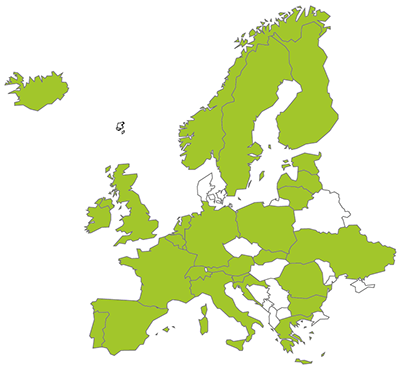
Quality Action is the EU co-funded ‘Joint Action on Improving Quality in HIV Prevention’ involving 45 partner organisations from 26 Member States, which started on March 2013 and ran for three years.

Quality Action promotes practical tools and materials to maximise the quality of HIV prevention projects and programmes. Five practical quality improvement tools are ready, available and translated into a range of European languages. They use different methodologies, have different degrees of complexity and each suits particular applications.

Quality Action has developed a Tool Selection Guide, to help identify which of the five tools to use for different projects and programmes. More than 80 practical applications of the tools have been developed and translated into case studies. Quality Action has trained more than 400 quality improvement trainers and facilitators from 25 different European countries.

Quality Action has developed two key documents to gain policy support and create an enabling environment for quality improvement. The ‘Charter for Quality in HIV Prevention’ summarises quality principles, criteria and key activities to put quality improvement into practice and offer practitioners, experts, policy makers and all other stakeholders the opportunity to commit to improving their work in HIV prevention. The Policy Kit offers policy makers the rationale and concrete actions for integrating quality improvement into HIV prevention policies, strategies and action plans.

What is structured quality improvement?

Quality improvement recognises and documents what works well and why, builds on and multiplies successes. Quality Action offers a structured approach, evidence-based principles and criteria, practical tools and trained experts.

The approach is based on the Plan-Do-Check-Act (PDCA) cycle, with stakeholder participation and self-reflection driving quality upwards. Quality improvement in turn identifies and documents quality standards. The main work of Quality Action was to integrate this approach into the existing conceptual and practical working processes of HIV prevention stakeholders in order to maximise uptake.

Coordination of Quality Action

From 2013-2016 Quality Action was co-funded by the European Commission as a Joint Action and coordinated by the German Federal Centre for Health Education (BZgA) in Cologne, Germany. Its three cross-cutting and five core work packages were led by governmental and non-governmental organisations based in Belgium, Sweden, Ireland, Germany and the UK.


Quality Action and IQhiv

The methodological concept behind Quality Action is based on the work of the IQhiv initiative, which was launched in 2009. IQhiv aims to:

  1. Promote the routine inclusion of quality improvement practices into HIV prevention across Europe at the project, program and policy levels; and
  2. Disseminate information on quality improvement practices that have been shown to enhance the effectiveness of HIV prevention at the project, program and policy levels.

Further information can be found on the IQhiv website.